
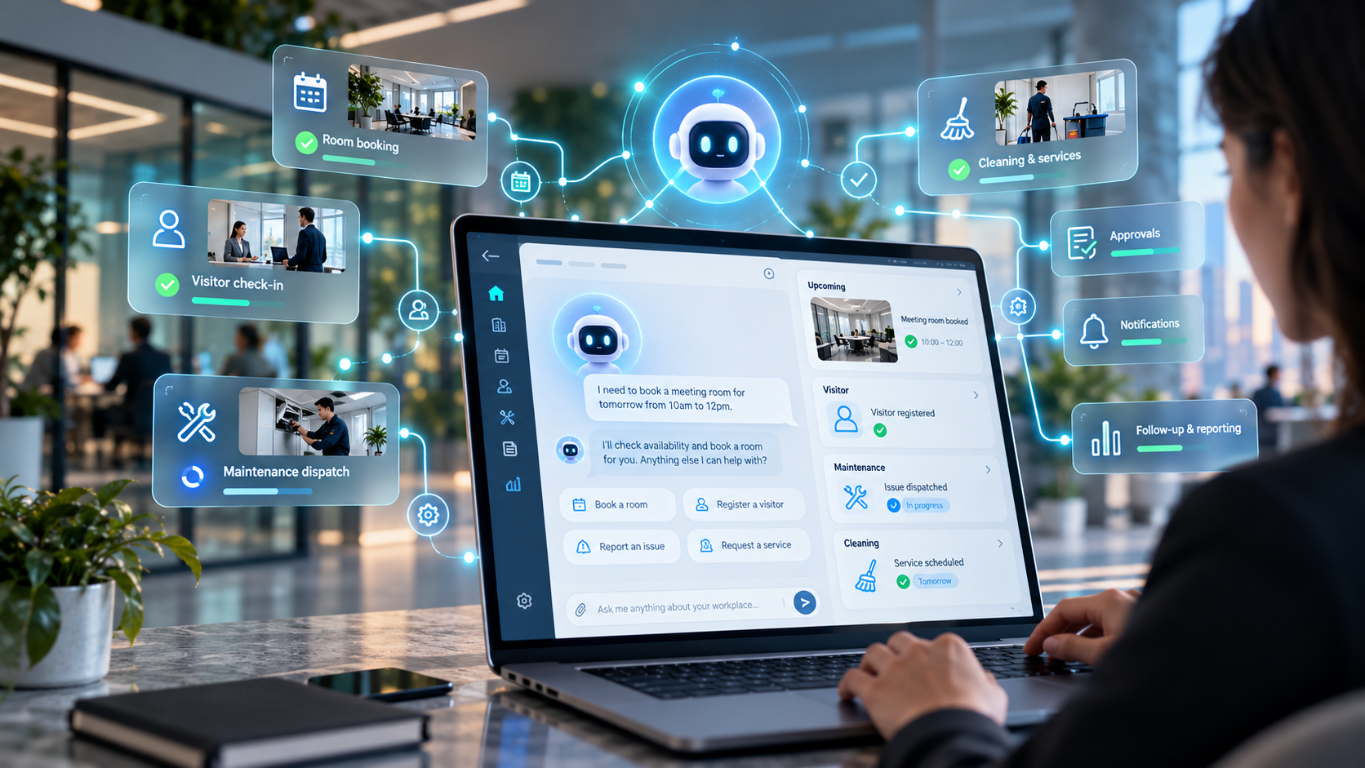
How AI, intelligent workflows and a new approach to employee experience could change Facility Management.
Think about a typical day at the office. An employee books a meeting room, registers a visitor, requests some equipment and reports a broken coffee machine. Four relatively simple activities, but often involving different applications, forms or even emails to the facilities team.
For employees, these are small interruptions in their working day. For Facility Management, they are part of a much larger operation involving buildings, assets, services, suppliers and people.
We have spent years digitising these processes. Yet many Facility Management Information Systems (FMIS) still expect users to understand how the facilities department is organised before they can request something.
I believe the next generation of FMIS platforms will fundamentally change this. Not necessarily by offering more functionality, but by making technology much easier to use and allowing intelligent automation to handle more of the work behind the scenes.
From Managing Facilities to Enabling the Workplace
Traditional FMIS applications have largely been designed around the needs of facilities professionals. They provide modules for maintenance, service requests, room reservations, asset management and reporting.
That makes sense from an operational perspective. But an employee doesn't think in modules or processes.
Someone who needs a meeting room doesn't want to navigate through a reservation module. Someone reporting a broken projector shouldn't need to understand the difference between an incident, a service request or a work order.
They simply want something arranged or fixed.
A modern FMIS should therefore start with the employee experience, while keeping the operational capabilities that facilities teams depend on.
Imagine being able to arrange a meeting room, visitor registration and catering in one simple interaction. Or finding an available desk near your colleagues without having to search through multiple screens.
The underlying processes may still be complex, but the employee shouldn't have to deal with that complexity.
A Conversational Interface: Just Ask for What You Need
One of the developments I find particularly interesting is the opportunity to introduce a conversational user interface.
Instead of navigating through menus and filling out forms, employees could simply describe what they need in natural language.
For example:
- "Find me a meeting room for eight people tomorrow afternoon, preferably with video conferencing."
- "The air conditioning on the second floor isn't working properly."
- "Can you arrange a visitor parking space for my customer next Tuesday?"
- "Where can I sit near my team on Thursday?"
The system would understand the request, use the available context and guide the employee through any missing information.
Importantly, a conversational interface doesn't mean eliminating traditional screens. A visual calendar is still useful for selecting a meeting room, just as a structured dashboard remains valuable for a facilities manager.
The opportunity is to combine both approaches. Use conversation when it's the easiest way to communicate an intention, and use a visual interface when it helps people make better decisions.
That could make facilities services accessible to employees who only use the system occasionally, without sacrificing the more advanced tools needed by professional users.
From Workflow Automation to Agentic AI
A conversational interface is only part of the opportunity.
The more interesting development is what happens after someone makes a request.
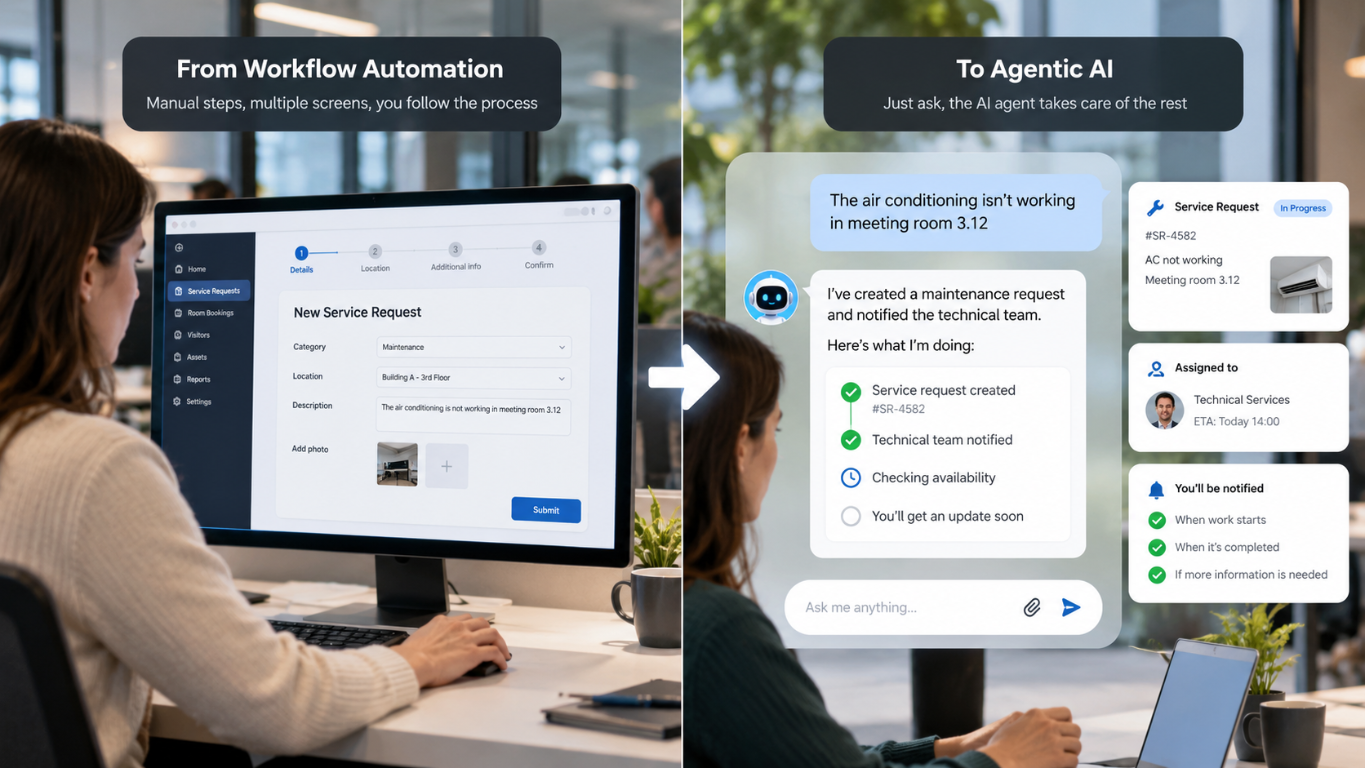
Most FMIS platforms already support some form of workflow automation. A new incident might trigger an email, assign a responsible team or create a work order.
AI introduces the possibility of taking this further, through what is increasingly called Agentic AI.
An AI agent doesn't just provide information. Within defined permissions and business rules, it can also initiate actions, coordinate activities and follow up on their progress.
Consider a water leak reported in an office building.
An intelligent agent could identify the location, classify the incident, determine the appropriate priority, check the relevant maintenance contract and prepare a work order for the responsible supplier. It could notify affected employees and monitor whether the supplier responds within the agreed service level.
If the issue remains unresolved, the agent could initiate an escalation.
Not every step should happen automatically. Actions involving significant costs, safety implications or sensitive information may still require human approval.
The objective isn't to remove people from Facility Management. It is to reduce repetitive coordination and administration, allowing facilities professionals to concentrate on exceptions, service quality and decisions that actually require their expertise.
Of course, this also introduces new requirements around accountability, security and auditability. An AI agent needs to operate within the same authorisation and process rules as any other user or system.
One Connected Platform Behind the Scenes
None of this works particularly well if the underlying information is scattered across disconnected systems.
A modern FMIS needs a consistent view of the organisation, buildings, spaces, assets, services and the people using them.
Take a defective projector. The system should know which room it belongs to, whether it is covered by a maintenance contract, who is responsible for fixing it and whether its unavailability affects upcoming room reservations.
That information should be available throughout the entire service process, without repeatedly asking employees or facilities staff to enter it.
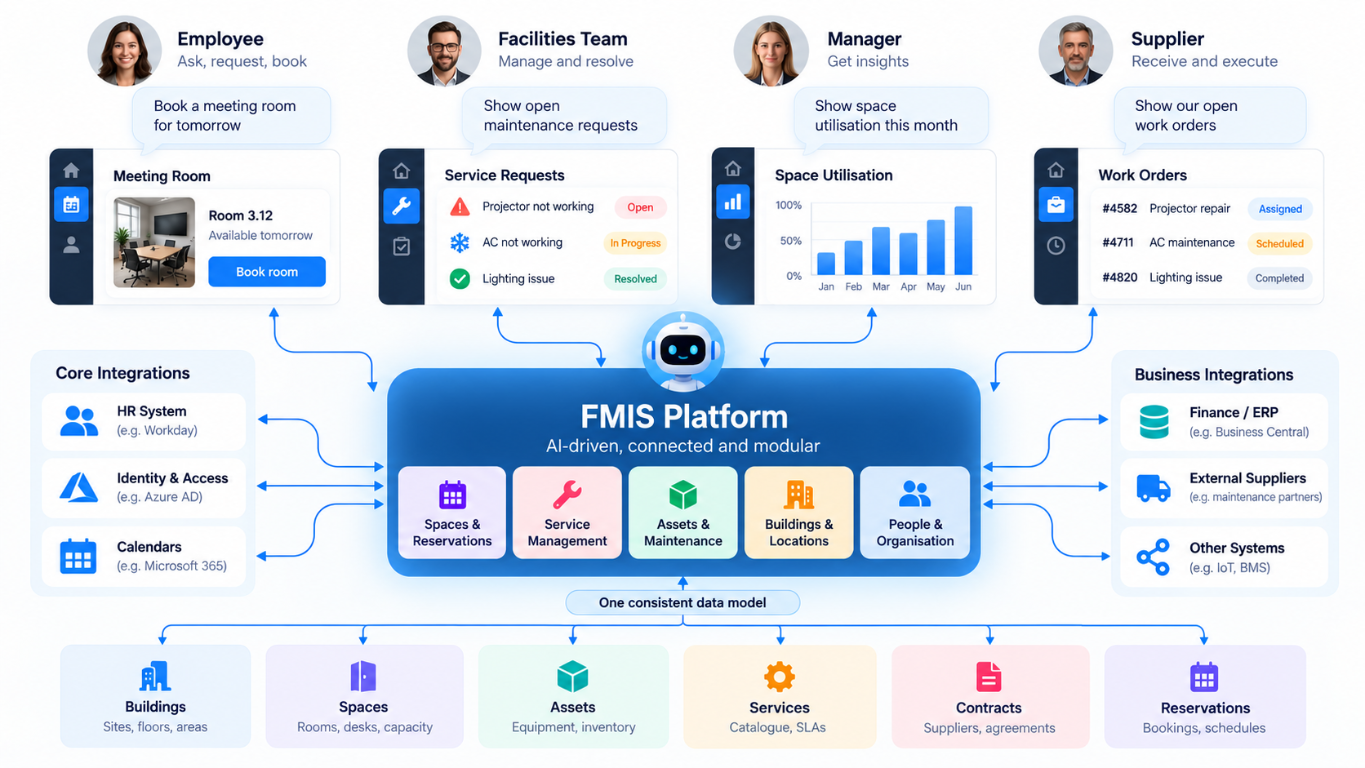
Integration is equally important. HR systems, corporate identity platforms, calendars, financial applications and external suppliers all have a role to play.
A modern architecture should make these connections straightforward, using well-defined APIs and event-driven integration rather than unnecessary custom development.
For small and medium-sized organisations in particular, this matters. They need professional facilities capabilities without the complexity and implementation effort traditionally associated with large enterprise platforms.
A modular approach, straightforward configuration and simple onboarding should make it possible to start with essential services and expand when the organisation needs more.
From Reactive Support to Proactive Facility Management
Another significant opportunity is using operational information more intelligently.
Most FMIS platforms can tell you how many incidents were reported last month or how many maintenance tasks remain open.
Useful information, but often retrospective.
What if the platform could also recognise recurring equipment failures, identify upcoming maintenance risks or highlight meeting rooms that are frequently booked but rarely used?
Instead of only reporting what happened, it could help facilities teams decide what to do next.
Combining operational dashboards with conversational analysis could make these insights much more accessible.
A facilities manager might ask, "Which buildings have the most recurring technical problems, and what is driving them?"
The platform could identify patterns, present the supporting records and suggest possible follow-up actions.
This doesn't require every organisation to employ data analysts or invest in a separate business intelligence environment. It requires reliable data, meaningful relationships between business objects and an interface that makes the information understandable.
Technology Should Become Less Visible
There is a risk that adding AI and more automation simply introduces another layer of complexity.
That would miss the point.
The real challenge is to make a sophisticated platform feel simple. Employees should have an intuitive experience on their phone or laptop. Facilities teams should have efficient tools for managing operational work. Management should have reliable information to steer services, costs and performance.
All while security, privacy, process controls and traceability remain in place.
The technology underneath will still be complex. But the user experience doesn't need to be.
I expect the most successful FMIS platforms of the coming years will combine traditional facilities functionality with intelligent automation, conversational interaction and a much stronger focus on the employee.
The real measure of success won't be how many features or dashboards a platform provides.
It will be how much easier it makes everyday work.
Perhaps the best FMIS of the future is one that employees barely notice. The meeting room is ready, the visitor is expected, the equipment is available and the broken coffee machine is being fixed.
And nobody had to figure out which system to open.